(404) 312-6640
Creating Connection with Urn Vaults
Just 12 years after the full funeral procession of President Abraham Lincoln, the first “modern” cremation was captivating the press nationwide. Within the first American crematory built in a small town southwest of Pittsburgh by abolitionist physician Francis Julius LeMoyne for his own interment, this event featured his acquaintance Baron Joseph de Palm, who had a particular fear of being buried alive and hoped to be reincarnated. The cremation “moment” was so monumental that doctors and scientists from as far away as Brazil and Switzerland made the trip, as well as reporters from nearly every major publication in the country.
Despite the meteoric rise and normalcy of cremation today, in 1876 that certainly wasn’t the case. Strong Judeo-Christian interpretations firmly eschewed disposition that harmed the body, but Dr. LeMoyne - after seeing repeated sickness and ailments in his fellow citizens - became convinced that contaminants from buried bodies were making their way back to the populace via water runoff. This propelled him to study cremation methods in Europe, only to be rebuffed and petitioned against when he returned home with an offer to his city council to fund the crematory himself. Undaunted, he proceeded with creating the stout 2-room brick building on his land that still stands to this day - a testament, however small, to innovation and perseverance.
This story, in my opinion, serves perfectly as a historical AND present day business lesson: seek to resolve unrealized problems.
Because whether or not Dr. LeMoyne was correct in his medical assessment, the resulting industry from this early and fervent adoption is a solution that still comforts families today, and provides an economical and personalized answer in the face of one of the hardest questions any of us will experience: there’s been a death, so what do we do now?
The world in 2021 is smaller than ever before in the history of mankind. You can order a shirt instantaneously from India while sitting in your pajamas in Kansas City, and then join your Grand-Mère for tea via video chat from her flat in Paris. The opportunities that abound from instant communication are endless as technology progresses . . . but what good is it if people still feel disconnected? If they sense the loss of community when major events occur . . . if the resulting isolation of living digitally feels overwhelming?
How can the death care industry, in particular those who work with cremated remains, compassionately address this pain point in the absence of the traditional funeral with a body present?
One solution to that unrealized problem: the creation of customizable cremation urn vaults, perfect for Celebration of Life ceremonies and the heartfelt and handwritten messages that people wish could live forever with their loved one.
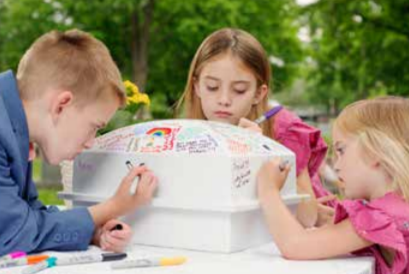
The typical Celebration of Life ceremony has adapted many customs from casket funerals. A burial site is decorated with a table for memorabilia and display of the urn, and chairs are in place for family members and friends to gather and tell stories. The procession of family and friends makes their way to the site, led by an appointed person, such as a pastor or family member, carrying the urn in the vault. Portraits and favorite items are on display, and the guests can take turns standing by the urn vault to share memories. Drawings and messages are inscribed on the vault before burial.
Southern Funeral Director Magazine w November/December 2021 13 Urn vaults are not new, of course, but for many families, this is their first experience with cremation and they have no traditions to rely on. We’ve heard nearly every reason that exists for the disinclination to use an urn vault: they’re not necessary; we don’t understand the purpose; they’re too expensive; we just want to buy the urn.
It’s easy enough to respond with beneficial facts - they’re often necessary for the surrounding ground’s integrity; their purpose is to keep your urn clean, dry and intact; compared to a full casket, they’re quite budget-friendly; it’s an easy purchase to keep as a memorial box if you decide to display the urn in your home with an option to bury at a later date.
However, facts aren’t what win over hearts and minds.
What we’ve found is that people are longing for a much deeper connection with the tradition of cremation - to imbue this method with the same ceremony, love and attention to detail that has been part of the casket burial tradition for millennia.
The urn industry certainly rose to the challenge - gorgeous brass, marble, porcelain, and hardwoods that allow for craftsmanship and a personal touch, since the very beginning of commercial cremation. Later advances such as laser engraving opened the door to more demographics who truly desired this personalization.
Yet these tastefully appointed urns were then encased in concrete or steel which, while sturdy, were utterly missing the personality of the urn within. The physical barrier also carried with it an emotional one - out of sight, the urn’s connection is shrouded and lost, now entombed in cold metal and stone too heavy to carry, and no longer a memorial that is interacted with in a meaningful way.
Enter the era of Crowne Vault polymer urn vaults: 3 lightweight sizes to suit every type of cremation container and customizable while still fulfilling the practical requirements of cemeteries everywhere.
All sizes are under 5 pounds, and the cremains, the urn and the vault together may weigh as little as 16 pounds (although more if the urn is made of a stone or marble, if it is a double inurnment and depending on any memorabilia enclosed). An elderly spouse may defer to an adult child, grandchild or friend to carry the urn vault at the head of a procession, which speaks volumes to importance and ceremony.
The beauty of a polymer urn vault is the ability to really interact with it as a proper resting place for a loved one’s urn. It’s not just an industrious box to be buried; with a little imagination, it becomes a lovingly warm bed with room for personal mementos, and the perfect way to directly create messages and draw meaningful art as a testament to the love you shared. Permanent marker and oil/acrylic paints are excellent ways to memorialize your thoughts on the vault surface, and offers people a way to express themselves without having to say anything. We’ve also had good success with our new Memorial Accent Collection - engraved adhesive nameplates, lifestyle emblems and handmade silk rose garland, which are perfect for customizing vaults with the kind of flair you’d find directly on the urn.
Another comforting aspect of polymer urn vaults is their ease of handling. This is not the laborious granite or concrete vault of bygone days; today’s vaults are sleek, modern, and easily carried with no extra equipment necessary. This culminates in a more inclusive experience that satisfies unrealized anxiety, where a husband can hold his wife, a mother can cradle her child, a son can take care of Dad one last time. The ability to take control of the physical aspect of burial is a meaningful way to “close” the process intellectually, and support the journey of grief, as people are not always comfortable physically interacting with an urn, but they take comfort in touching a casket or urn vault. That’s not to say that funeral home and cemetery staff are being removed from the equation. On the contrary, families require just as much, if not more, direction and reassurance when they are assuming more responsibility for the logistics. The details of weather, site traffic and grounds preparation are still the forte of professionals and the importance of this educated planning is paramount.
Hosting a Celebration of Life ceremony for a cremated person is such a loving way to honor their memory and join with others who loved them, in the way that you would with a casket burial. The focus becomes about sharing stories and decorating the urn vault with treasured phrases and icons. Memories crop up, laughter is brimming and healing is happening with this community of people who are brought together by a shared love.
At the end of the day, people want and need to express their sorrow in a way that has deep meaning for them. The ability to provide a product which fulfills that promise and encourages a more hands-on approach than was historically available is such a humbling way to serve people and facilitate love in the world of death care.
Previous Posts
Safety is Not a Luxury for Funeral Homes and Cemeteries
THE BEST LAWSUIT IS THE ONE THAT NEVER HAPPENS: Five Lessons from the Witness Stand
UNLICENSED PRACTICE The Unnecessary Regulator Windfall
HEARSEMANIA’S OHIO HOMECOMING
Maximizing Your NFDA Trade Show Experience
9 Unforgettable Funeral Processions
Guiding Families Through Monument Selection
Community Events Strengthen Communities
Evolving Community Outreach
DON’T FEAR AI— TRAIN IT.
 (317) 608-8914

 Joe Weigel
Associate Editor
9 Birchwood Ct.
Batesville, IN
47006
Comments